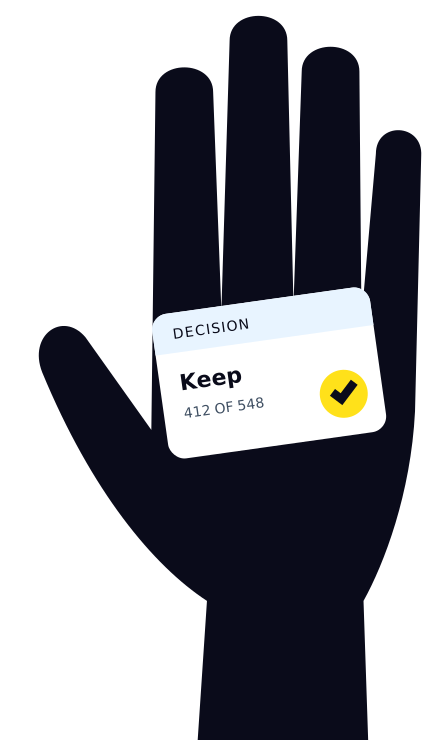
Run AI lead qualification with Sorzio Decision Mode (typesafe-ai/jev-1.14.0) to evaluate thousands of prospects into deterministic keep, reject, and unsure routing buckets at $1.00 per 1,000 rows base plus 1.25x input tokens (around $1.01 per 1,000 rows total). Because Decision Mode computes calibrated classification probabilities rather than free-form chat paragraphs, row 1 and row 10,000 apply identical ICP thresholds inside Google Sheets and gated Flows.
Why prompt-based AI lead qualification breaks across large outbound lists
Ask a standard chat model to "rate this lead 1 to 10 for our ICP" across 5,000 rows and three failures appear immediately:
- Score inflation and threshold drift: Subtle phrasing shifts inside
{{website_summary}}make generative models award7/10to borderline agencies one hour and4/10the next, ruining campaign consistency. - Overspending downstream enrichment credits: When teams run Personal LinkedIn enrichment ($0.01/row), Live Web Search, and AI copywriting on every row before qualifying accounts, 50% to 70% of the budget goes toward companies you would have disqualified on sight.
- Unparseable text wrappers: Generative prompts emit apologetic sentences around scores unless you maintain brittle JSON retry parsers.
Calibrated Decision Mode separates fast binary/threshold judgment from generative writing. You run it immediately after a $0.006 6-page website scrape inside Sorzio Flows, route reject leads out immediately, review unsure edge cases on a 10-row test sample, and only pay for downstream enrichment and personalization on keep accounts.
| Qualification Approach | Consistency Across 10k Rows | Downstream Cost Control | Unit Economics |
|---|---|---|---|
| Rule-only CRM / spreadsheet filters | Rigid exact-match only | Misses pricing model & positioning fit | High manual QA time |
Generative LLM prompt (1 to 10) | Subject to prompt drift & hedging | Often paired after full enrichment | 1.65x full token burn + $0.0035/row |
Sorzio Calibrated Decision Mode (jev-1.14.0) | Deterministic probability thresholds | Native 3-way Flow gate (keep, reject, unsure) | $1.00 / 1,000 rows base + 1.25x input (~$1.01/1k) |
Gate-first qualification architecture in practice
Suppose you start with 10,000 raw domains and only 35% match your buyer criteria. Enriching Personal LinkedIn ($0.01/row) and verifying emails ($0.01/row) on all 10,000 rows would cost $200.00 before AI copywriting even begins. Placing a calibrated Decision Mode gate right after initial website enrichment (~$10.10 total for 10,000 decisions) trims downstream spend to the 3,500 keep leads ($70.00 instead of $200.00), cutting total enrichment spend by well over half.
Read our full implementation framework in the ICP scoring with Decision Mode playbook, model your exact list drop-off rate with the cold email cost calculator, or compare credit multiplier pricing in Sorzio vs Clay.
Common questions
What does calibrated Decision Mode cost on Sorzio?
Decision Mode (typesafe-ai/jev-1.14.0) charges a $1.00 per 1,000 rows base fee ($0.0010 per row) plus 1.25x input tokens, typically landing around $1.01 per 1,000 evaluated leads.
How is Decision Mode different from prompting GPT or Claude in a spreadsheet cell?
Generative chat models predict conversational next tokens, so small wording shifts change numeric scores across batches. Decision Mode outputs calibrated probabilities and maps every row cleanly to keep, reject, or unsure for automated Flow branching.
Can I calibrate Decision Mode before running it on 25,000 rows?
Yes. In both Google Sheets and Claude/ChatGPT MCP (preview_decision and 3, 10, or 50-row test mode), you inspect scores alongside edge cases first, refine your qualification spec, and only then launch the full batch.
Does Decision Mode work on Hosted Lists in Claude and ChatGPT as well as Google Sheets?
Yes. You can execute calibrated Decision Mode rules inside the Google Sheets add-on, directly inside multi-step Sorzio Flows, or from Claude and ChatGPT via https://www.sorzio.com/api/mcp.